בפרק הזה
בקצרה
זמן קריאה: 3 דק׳
Discriminatory Pricing by a Monopoly – Third Degree
In third-degree price discrimination, a monopoly can differentiate between consumers with different demands, but the price per unit of product is uniform for each type of consumer. This is possible, for example, when there are geographical distances between consumers. The monopoly can charge a different price for a can in Tel Aviv compared to the same can in Safed, without fear that a consumer from one city will travel to the other just because the can is cheaper. The idea is to charge a higher price from populations with more inelastic demand.
Israeli anchor
Think about movie tickets: students pay less, soldiers get discounts, seniors get reduced rates — same movie, different prices. Israeli bus companies (Egged, Dan) do the same with Rav-Kav categories.
Intuitively, the monopoly will produce such that the following equality holds:
- Marginal Cost = Marginal Revenue of Population B = Marginal Revenue of Population A
As long as the marginal revenue in one of the populations is higher, the monopoly will sell more units of the product there, and the marginal revenue will decrease according to the demand curve of that population. In equilibrium, the marginal revenue in each population will equal the marginal cost. Prices in each population will differ because the marginal revenue curves are derived from the demand curves, and the demand curves are different. The difference in demand curves is the reason for charging a different price from each population in the first place.
Diagram 5.1 – Monopoly Discriminating Third Degree – Population A
Diagram 5.2 – Monopoly Discriminating Third Degree – Population B

Diagram 5.3 – Monopoly Discriminating Third Degree – Aggregate
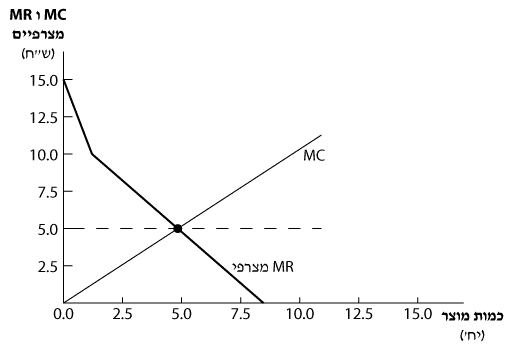
According to this example:
- 5 NIS = Marginal Cost of the Monopoly = Marginal Revenue of Population B + Marginal Revenue of Population A.
- In Population B, the demand is more inelastic. Therefore, a third-degree discriminating monopoly will charge Population B 10 NIS per unit of product. Population A has more elastic demand, so they will be charged 7.5 NIS per unit.